
IMAGE DESCRIPTION: A skeleton with an old-fashioned camera (adorned with a large red ribbon) for a head stands in profile but looks at the audience. A dog skeleton with a flash device for a head sits and gazes raptly at the camera-person’s face. The flash-dog wears a red collar with tags. The background is a black-framed photograph of the night sky (with full moon) in black and white but with colored lights in the extreme foreground. “#100” is written in red on the white mounting surrounding the photograph and is visible between the two skeleton figures. A piece of beige masking tape appears at the very top of the photograph’s frame as if the frame and its contents are taped together.
ISSUE 100
CONTENTS
JULY 2023
Amanda Pszczolkowski
Carmen Calatayud
Victoria Lau
Emily Murman
Therese Gleason
ART: Nadia Arioli
Adesiyan Oluwapelumi
Diane LeBlanc
Kathy Nelson
Marcela Sulak
Timmy Chong
CONTRIBUTORS
Amanda Pszczolkowski
MANDY
Mandy is beautiful and she kisses me
and this is why I love her. I love that
her hair smells good and that her smile
fails to offend me. I love that she is not
like other girls. I love that she is
a lady. I love that I am the only one
who gets to call her Mandy, I love that
I’m the only one who gets to grab her
by the throat, that word for me
and the front counter barista’s pen.
If she were to bare teeth across every booth
in America when someone asks
has she ever been called that before
that saccharine No could waterboard me
like an ant trap. I’d be comatose, Mandy,
and it is your fault. You did this. Mandy, stop
digging in the flower bed; your nails
will get dirty. Those bruises on your knees
were mine and the pew’s, so get up, Amanda.
God, would you look at yourself?
I thought you were cool.
Carmen Calatayud
HUNGER DREAM
Comunidad Valenciana, España (1939-1942)
This violet sky rains almonds.
I try to catch one on my tongue.
The rest drop to the ground and
We gather them in sacks for sustenance.
Our dreams brown almonds.
Our eyes brown almonds.
We stop to break open a few and
Eat together. We kneel because our
Ancestors gave love to these native trees.
The tree limbs grew to the clouds, and
The clouds released almonds.
We smuggle almonds in aprons and pants.
The wind is hungry so we feed it almonds.
We labyrinth our way home with
Hope that flies inside our skulls.
Our DNA sings under the sun.
Today we don’t taste blue emptiness.
We taste bark, branch and shell.
For tonight we are stripped of wild twilight fear.
Victoria Lau
MASTER PADLOCK SESTINA
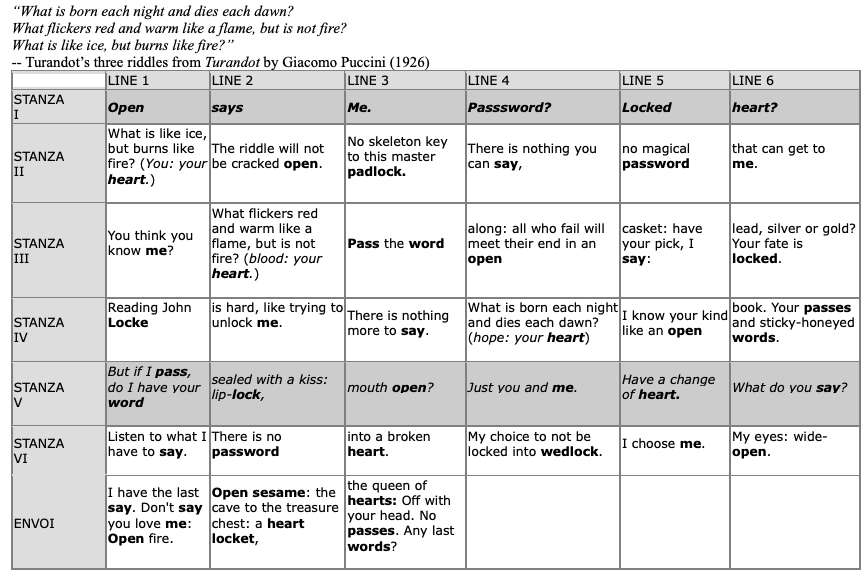
IMAGE DESCRIPTION: The image looks like a an Excel table or a master padlock with an ivory background and beige boxes around the row and column headings. The following words appear above the table or padlock:
What is born each night and dies each dawn? / What flickers warm and red like a flame, but is not fire? / What is like ice, but burns like fire? / Turandot’s three riddles from Turandot by Giacomo Puccini (1926).
The table or padlock itself includes 6 columns headed LINE 1 - LINE 6 and seven rows titled STANZA I – STANZA VI and ENVOI.
STANZA I has a pale brown background. From left to right, this row says: Open / says / Me. / Password? / Locked / heart?
STANZA II reads: What is like ice, but burns like fire? (You: your heart.) / The riddle will not be cracked open. / No skeleton key to this master padlock. / There is nothing you can say, / no magical password / that can get to me.
STANZA III says: You think you know me? / What flickers red and warm like a flame, but is not fire? (blood: your heart.) / Pass the word / along: all who fail will meet their end in an open / casket: have your pick, I say: / lead, silver or gold? Your fate is locked.
STANZA IV says: Reading John Locke / is hard, like trying to unlock me. / There is nothing more to say. / What is born each night and dies each dawn? (hope: your heart) / I know your kind like an open / book. Your passes and sticky-honeyed words.
STANZA V also has a light brown background. It says: But if I pass, do I have your word / sealed with a kiss: lip-lock / mouth open? / Just you and me. / Have a change of heart. / What do you say?
STANZA VI reads: Listen to what I have to say. / There is no password / into a broken heart. / My choice to not be locked into wedlock. / I choose me. / My eyes: wide open.
The ENVOI says: I have the last say. Don’t say you love me: Open fire. / Open sesame: the cave to the treasure chest: a heart locket, / the queen of hearts: Off with your head. No passes. Any last words?
Emily Murman
HAUNTED HOUSE
so this is what it feels like
to enjoy controlled sensory overload.
it’s slipping past dead dummies
swaying in plastic bags spattered w/
fake blood & something the color of puke.
chartreuse. you are mincing in front of me
trying not to trip on tiptoes.
a low-pitched air horn blares,
splaying the hair around my ear.
even though I live for this shit,
it’s a tight fit for two autistics.
I feel the warm strobes on my face.
the churning fog is so thick
that the axe murderers lurking
in our sweet, plasticky cloud
don’t even register at all.
I can feel your arm around
me. I can feel thumps
from other bug-a-boos
around, urging us along.
here come those uninhibited freaks.
let us be more like them.
Therese Gleason
SELF-PORTRAIT AS WARMING PLANET
The sky burning from the top
down, ocean a churn of cinders.
My brow molten, I hiss, spitting
lava into the smoking sea.
Singed feathers float. Which way
is up? Fish gasp, dolphins pant. I flush,
sweat, cry. Don’t even try to deny it.
Once a friend wrote I can make a bird
fly out of your mouth backwards. I wish
I could do that. Put things in reverse.
Right things. My ovaries are misfiring,
brain aflame. How will birds fly
with a hole in the sky? A gull pecks
my right temple with a sharp beak.
Is it still a menstrual migraine
if you no longer bleed? The Bible
says the body is a temple, to go forth
and multiply; the earth is also a body, ergo…
My skin cracks. It’s the end of pink,
of green, fields barren and dry.
The plates of my skull rumble,
tectonic—although I know
this pain can’t kill me, I don’t know
if I’ll survive. Soon I’ll be invisible.
A jagged line rends the curtain of sky,
the horizon rising. Is it too late to beg,
apologize? My last kiss blisters
the world goodbye.
*the phrase the end of pink is borrowed from Kathryn Nuernberger’s collection of the same name
Nadia Arioli
I GOT PREGNANT
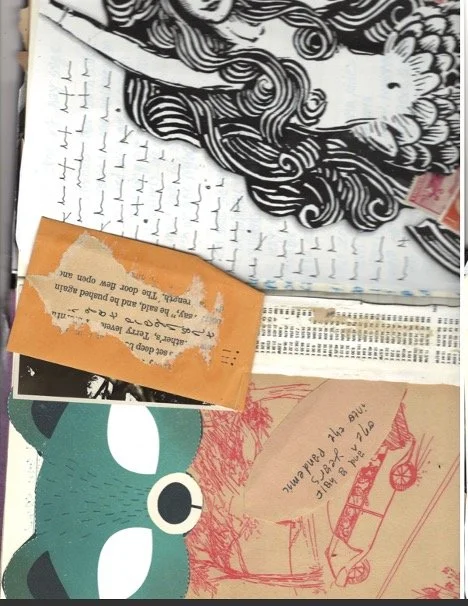
IMAGE DESCRIPTION:This collage of overlapping papers is divided into two horizontally. The upper half of the image includes the black-and-white figure of a mermaid with upper-face and tail off the page. The mermaid lies over a white page with (illegible) black handwriting that resembles a diary entry. The lower half includes a teal bear face with eyes cut out and a beige page with a car and tree drawn on it in pink. The handwritten words “One (and a half) years into the pandemic” appear over this drawing on another piece of paper. The horizontal center of the image includes a white paper with rows of numbers like a receipt or ticker-tape and a fragment from a book page set on an orange slip of paper.
NOBODY TOLD ME HOW LONELY
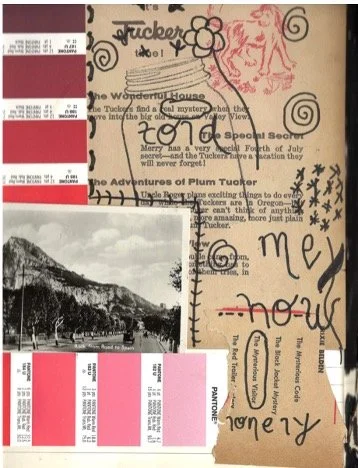
IMAGE DESCRIPTION: This collage includes paint samples in shades of red and pink and a black-and-white photograph of a tree-lined street with a steep mountain nearby. This mountain suggests that the photograph shows the California coast. The background is a page from a book of poems with an animal drawn in pink and the words “Tucker told me how -onery” written down the page in black ink. Behind these words, readers will make out poems titled “The Adventures of Plum Tuoker,” “The Special Secret,” and “---the Wonderful House.” The page also includes a line drawn in pink ink and a flower drawn in black ink. Words from another poem (“The Mysterious Visitor”) are circled near the bottom of the page.
STUNNED TO SEE
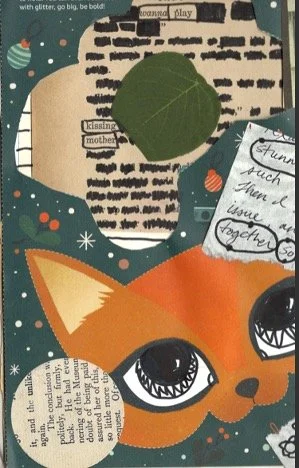
IMAGE DESCRIPTION: This background is a dark teal that resembles card stock. It is covered with an orange cat face, a green leaf, and three fragments of book pages or stationary. The spaces between these additions are filled with small drawings of snowflakes, ornaments, or holly sprigs. The text on the book pages is deliberately illegible, but a small note with the handwritten words “stunn- / such / Then I / issue / together so” is visible. The words “stunn-,” “together,” and “so” are all circled in black ink.
Artist statement:
Living as AFAB, I have grown used to the idea of my body as not my own. It is for men, for consumption, for trauma, for disgusting, for bad. Then, my body became a home for someone else, namely, my son. And that was miraculous, but also strange. As my son grew in my womb, I tried to make sense of having / not having a body using trash I found. My son can use his environment to make a life, then so can I.
Adesiyan Oluwapelumi
BLESS THE HEADACHE // ODE TO BODY
I
Malleable ache, bearable anguish.
Bless the headache.
And every pain that came as bone.
Bless the gravity-bearing vertebrae.
The soft bruise, the tender tear.
The loose wound, the silky skin.
Bless the knitting & the breaking.
The mild trauma, little tumors .
Bless the barring cancer.
The spiked teeth, the mane.
The whiskers of sensitivity.
The unfurling tendrils of anoxia.
Bless the ceaseless breathing.
Globulets of tiny phagocytes.
Malignant cells. Burnt lungs.
Bless the trying deaths.
II
Malodorous concentrate, pale tablets.
Bottle of ginned syrup.
Self-portrait with alcoholism.
The spent nights, the drunk mornings.
Vomit comets, hangovers, anorexia.
Reckless abandon, nudity, tattoos.
Piercing tongue, liquid apple.
Psychiatrist, Physiotherapist, Ophthalmologist.
Crime, scene, weapon: body.
Pelt ridden with spikes.
Wet burns, thick tears.
Hypothecation & damage.
Flesh & license.
Bless the unholy body.
Diane LeBlanc
HOW TO WRITE AN ELEGY
Salvage the tin wings you find strapped to a chain link fence.
Choose an adjective for absence.
Name the missing body after your best friend in kindergarten and make it a paper nametag
hung on thick blue yarn.
Devote several years to summoning angels in bars and thrift stores, believing you can mend the
thinnest specimen of faith.
Then, on a rainy night in April, close the curtains and slip your arms through the wires that hold
the wings. Don’t be surprised if the wire cuts. Put on your flannel robe and try again.
As you look in the mirror and see the wings sagging from your shoulders, ask yourself how it
came to this. Salvage and grief. Nostalgia. And now regret.
You could have left the wings where you found them. You could have imagined a body. And
what lovely paint you could have made of quince and mud to bloody the wings.
But you didn’t.
The wings smell faintly of an old watering can. They make your tongue ache for rain.
Spend the evening wondering if the wings you’ve put on are more like a rosary than a costume,
once blessed never to be worn. But keep the question to yourself. Tomorrow you’ll return the
wings to the fence, and the story you tell will have no yarn or robe or regret.
Kathy Nelson
TACO TUESDAY
Maybe this is mirage, this belonging,
grandbaby on my shoulder, eighteen days, already holding up her wobbly head,
daughter in the kitchen shredding chicken,
older grandkids showing me their homework
or downstairs playing foosball, husband still
here after all the ways I’ve maimed him,
or maybe the mirage was that concrete curb
where I slouched—fetal—until a stranger
leaned to help then silently turned away,
or maybe the jagged scar on my belly
where something red and squalling and helpless
was taken out but not a baby, no one
telling me Push Push, mirage.
Marcela Sulak
STORY BOARD
In this story I am the witch of the west, the evil stepmother, the siren, that kind of thing, this is
just a mockup, we can work out the details later, in this story I make everyone feel like shit. The
less I appear in the story the bigger I grow. I do not like it here in this particular story and the
other characters resent it when I try to escape into the double space after each full stop and the
double spaces between paragraphs or the single spaces between words. I have tried them all.
They are always catching me by the serif and pulling me aback in. Without me the words would
have no spaces, and nothing would make sense.
Timmy Chong
SUNSHOWER SONNET
Road as a runway, stokes in the soapbox,
rinsing to the whistle from the windows.
And flickering reams of solar, clustering
senselessly, but a prism sending signals
into luminous bliss, until blocked by the
bridge, or cumulonimbus culled by fluff,
shoulder-to-shoulder like soldiers in line
for sunbathing. Saturation vapor relaxes
a rhythm like a summer told by timpani,
or a comet almost falling into orbit, and
either way it's gorgeous, much like a gift.
Much like I missile on the balcony, I may
shutter my eyes for the road, from miles
to closed. The rain runs da capo al coda.
Issue 100 Contributors
Nadia Arioli is the editor in chief of Thimble Literary Magazine. A three-time nominee for Best of the Net, Arioli’s poetry can be found in Cider Press Review, Rust + Moth, McNeese Review, and elsewhere. Essays have been nominated for Best of the Net and the Pushcart and can be found in Hunger Mountain, Heavy Feather Review and elsewhere. Artwork has appeared in Permafrost, Kissing Dynamite, and Poetry Northwest. Arioli’s latest collections are with Dancing Girl and Kelsay Books.
Carmen Calatayud is the daughter of immigrants: A Spanish father and Irish mother. Her book In the Company of Spirits (Press 53, 2012) was a runner-up for the Academy of American Poets Walt Whitman Award. Carmen’s poetry and nonfiction have appeared in print and online in The Banyan Review, Cutthroat, The Manifest-Station, OyeDrum, Poet Lore, Verse Daily, and various anthologies. She is a Larry Neal Poetry Award winner and a Virginia Center for the Creative Arts fellow living in San Antonio, Texas.
Timmy Chong is Korean and Chinese and childish. He's a twenty-something dogfather and copywriter from Maryland, and was a finalist for the 2023 Iron Horse Chapbook Competition. His poems have been shared in Rogue Agent, Up The Staircase, Drunk in a Midnight Choir, and other lovely, funky, possibly defunct places.
Therese Gleason is author of two chapbooks: Matrilineal (Honorable Mention, 2022 Jean Pedrick Chapbook Prize, New England Poetry Club), and Libation (co-winner, 2006 South Carolina Poetry Initiative Competition). Her poems appear in 32 Poems, Indiana Review, New Ohio Review, Painted Bride Quarterly, Rattle, and elsewhere. Originally from Louisville, Kentucky, she is a literacy specialist and creative writing instructor at Clark University in Worcester, MA, where she lives with her family. Find her at theresegleason.com.
Victoria Lau holds an MFA degree from Lindenwood University. She was the 3rd place poetry winner for the Random House Creative Writing Competition in 2013. Her poems have been published in Rogue Agent, The Orchards Poetry Journal, Gyroscope Review, and The Olivetree Review. She was also the 1st place winner for the Nancy Dean Medieval Prize in 2020. She was a poetry reader for GASHER Journal and is one of the marketing coordinators for The Adroit Journal. She has taught poetry at Sadie Nash Summer Institute. She is writing assistant at the Borough of Manhattan Community College Writing Center and an English adjunct lecturer at Queens College. Follow her IG: victoria.lau_calliope_poet.
Diane LeBlanc is a writer, teacher, and book artist with roots in Vermont, Wyoming, and Minnesota. She is the author of The Feast Delayed (Terrapin Books, 2021) and four poetry chapbooks. Poems, essays, and reviews appear in Bellingham Review, Bellevue Literary Review, Cimarron Review, Mid-American Review, Stirring, and Sweet Lit among others. Diane is a holistic life coach with emphasis in creativity practice. She teaches at St. Olaf College in Northfield, Minnesota. Read more at www.dianeleblancwriter.com .
Emily Murman is a poet and mortuary student from Chicago. She holds an MFA from National University and is the author of three chapbooks, SHRIVEL AND BLOOM (Dancing Girl Press, June 2021), I want your emergency (Selcouth Station Press, July 2021), and hey nonino (forthcoming with Dancing Girl Press). Emily can be found on Twitter and Instagram @emilymurman.
Kathy Nelson, 2019 recipient of the James Dickey Prize (Five Points), is a graduate of the Warren Wilson Program for Writers. Find her work in her chapbooks, Cattails and Whose Names Have Slipped Away, in her collection, The Ledger of Mistakes (forthcoming from Terrapin Books) and in LEON Literary Journal, New Ohio Review, Tar River Poetry, Valparaiso Poetry Review and elsewhere.
Adesiyan Oluwapelumi, TPC XI, is a Nigerian writer with a bizarre appetite for tomatoes. He is the winner of the Cheshire White Ribbon Day Creative Competition 2022 & an Honourable Mention recipient in the Starlit Winter Awards 2022. His works have appeared in Poetry Wales, IHRAF Publishes, Brittle Paper, Kissing Dynamite, Lumiere Review, Asterlit, and elsewhere. He stans Timi Sanni & tweets @ademindpoems.
Amanda Pszczolkowski is a writer and a lover of bigfoot and crossword puzzles. She graduated from Grand Valley State University with a B.A. in writing in 2021. Her poetry has been published in Voices and Stanchion. She lives and writes in Grand Rapids, Michigan.
Marcela Sulak is the author of the lyric memoir Mouth Full of Seeds. She’s published four poetry collections, most recently, the National Jewish Book Awards finalist, City of Sky Papers. “Storyboard” will appear in her novella-in-verse, The Fault, forthcoming in 2024 with Black Lawrence Press. Sulak directs the Shaindy Rudoff Graduate Program in Creative Writing at Bar-Ilan University.