ISSUE 75
CONTENTS
JUNE 2021
Jessica Poli
Terhi K. Cherry
Adrienne Burris
Sara Quinn Rivara
Lannie Stabile
ART: Chanika Svetvilas
Cynthia Bargar
Cameron Morse
Kim Michalak
Samuel Ugbechie
Pamela Hobart Carter
CONTRIBUTORS

IMAGE DESCRIPTION: This colorful and labeled diagram of a human heart is decorated with flowers. The parts of the heart, including major veins and arteries, are colored in white, red, and blue. The flowers are bright orange, yellow, white, or white with purple stripes.
Jessica Poli
HAPTIC CENTO
I wanted you to touch me
almost endlessly.
I dreamed as I waited
in the early dark
while my very bones sweated
hunger. Dreamt of snakes
beneath the forest.
My legs open. The air full of water.
If we are made in God’s image,
I was as good as I would ever be. In the dark, the ruddy
glow through my breastbone:
some part of me that, almost,
is closer to me than I am to myself.
With lines from Rae Armantrout, Michael Burkard, Leila Chatti, Donika Kelly, Alicia Ostriker, Carl Phillips, Jean Valentine, and William Carlos Williams
Terhi K. Cherry
WHEN ARE YOU HAVING CHILDREN?
I heard NASA found water
on the moon’s sunlit side. I thought it was barren,
like Becky’s cousin, an addict, who conceived
with her meth-cooking boyfriend.
Sarah’s younger sister lives on soda and chicken,
expecting her second child. I'm having a hard time
believing I should give up
my cup of coffee.
Every morning I stumble,
eyes half shut into the bathroom. Pee in a cup.
Line up dollar store sticks like suspects,
month after a month, a blank stare.
Because Venus can’t support life in thick atmospheres,
I cut carbs. Because the dress left hanging
on the changing room door belongs to a woman
whose children all died.
The front porch shrouded in wisteria,
choking out anything living.
Like the lining of the womb grows into wrong places,
no mother should bury her children.
Every nest I built has shed, each shade of blood
turned to rust, month after month I searched
for the same information on discussion boards:
What if it’s bright red?
A trigger warning. It’s not a baby dance:
It’s Peggy pressuring her depressed boyfriend,
because the app screams ovulation.
It’s not baby dust: It’s cum.
It’s her face wet from crying because he couldn’t finish.
It’s her knocked-up dentist pushing tools
inside her mouth, smirking,
how women bang their husbands all wrong.
It’s women meeting donors
in Starbucks restrooms, a needless syringe in handbags.
It’s nitrogen tanks, empty bank accounts,
because the insurance won’t cover.
When Hannah walked from Harlem to the Hudson River,
she swore by exercise. Saw seven pregnant ladies.
The clinic called. None of her eggs had fertilized.
She could try another round,
take another needle, open her legs to a harvest
like a gut-hooked fish thrown back in the sea.
Or she could break some windows.
She too had tried Mucinex, Robitussin, grapefruit juice.
Flushed her tubes with Xi Xian Cao.
Bit into pineapple core. Hung upside down,
pillows under her hips, thinking
she can’t methylate. She breathes four-seven-eight,
slips on a dress, hides unruly ovaries, sits by the door
in a baby shower crowd, choking
on the name choices, the nursery décor.
A woman taps my hand, wants to know
when I am having children.
I wonder if she’s heard,
on the outskirts of Rome they bury tissue
scraped from women’s wombs,
display the women’s names on a cross.
I want to tell her, a witch in Kalamazoo
hand-poured me a candle, I smeared it
with what came out of me.
Burned it for three days, found a dead moth
in the cutlery drawer, a pigeon’s egg
near my door. My mother just dangled her legs
out the window, and my father asked
for a smoke. In the next picture,
my brother was born.
I wish the moon would break its water,
bring the rain, drench me.
Adrienne Burris
HUNGER
My preferred meal was To Not Be a Burden:
kids’ macaroni, tap water, ketchup packets.
My brother? To Be Memorable: give him a
large chicken alfredo, virgin banana daiquiri.
Four bites and he was full or something like it.
My husband? Well - in the restaurant gift shop,
looking for nothing, he does that thing he does:
grabbing toys to dance, wiggling sunglasses and
eyebrows. I death glare behind the postcard stand.
But then he takes ears with red and black sequins,
puts them on my head duck-faced and for some reason
I leave them on. I lower my to-go box of leftovers
and I smile. And I had not smiled in so long, or so rarely,
he says we have to buy them, and when I try to put them back
he marches to the clerk, he won’t take no for an answer.
My husband? To Be Happy.
I calculate how many times to wear them,
how many smiles could make $29.99 worthwhile.
Sara Quinn Rivara
LEDA AFTER THE SWAN
I bought a pregnancy test at the party store near the river where a man was found floating face down, and before the ambulance arrived I touched his skin, cold and pink as the tile of the Elks Lodge bathroom where afterwards I stopped to pee. The bar was full. There were bushtits in the cedar that rasped its branches against the bathroom window, cigarette smoke fuzzed the walls like moss. When I walked past the men at the bar, one of them slipped his hand up my skirt and called me sweetie; another whistled at me like a bird. My throat swelled shut. A bushtit makes a nest out of moss, lichen, strands of human hair, then abandons it after the eggs are hatched. A pregnancy test takes three minutes. I reapplied my mascara, bit my lips till they bled. The sky pinked, drained into the river. A small pink cross appeared, faint and tremulous, on the plastic test. The door squeaked on its hinge as it swung shut. At the bar, a man put his hand on my leg. I let him. I know you have stories about women like me.
Lannie Stabile
THE PLURAL OF CYCLOPS IS CYCLOPES
A girl can carry her drink to the bathroom,
or a friend can guard it within her wool.
She can spot and uproot red flags
like a row of Washington Apples.
A girl can call an Uber,
or substitute water for undiluted wine.
A girl can travel in a flock,
or tuck keys between her knuckles
like Hellenistic soldiers.
She can even master Krav Maga
and the myth of prevention.
A girl can occupy a barstool all night long,
with a vigilant eye on her glass,
but when the SAFE kit is processed
in the morning, police will insist
there is nobody to blame.
This poem is reprinted from Good Morning to Everyone Except Men Who Name Their Dogs Zeus, (Cephalo Press, 2021).
Chanika Svetvilas
SIDE EFFECTS SERIES (STIGMA)
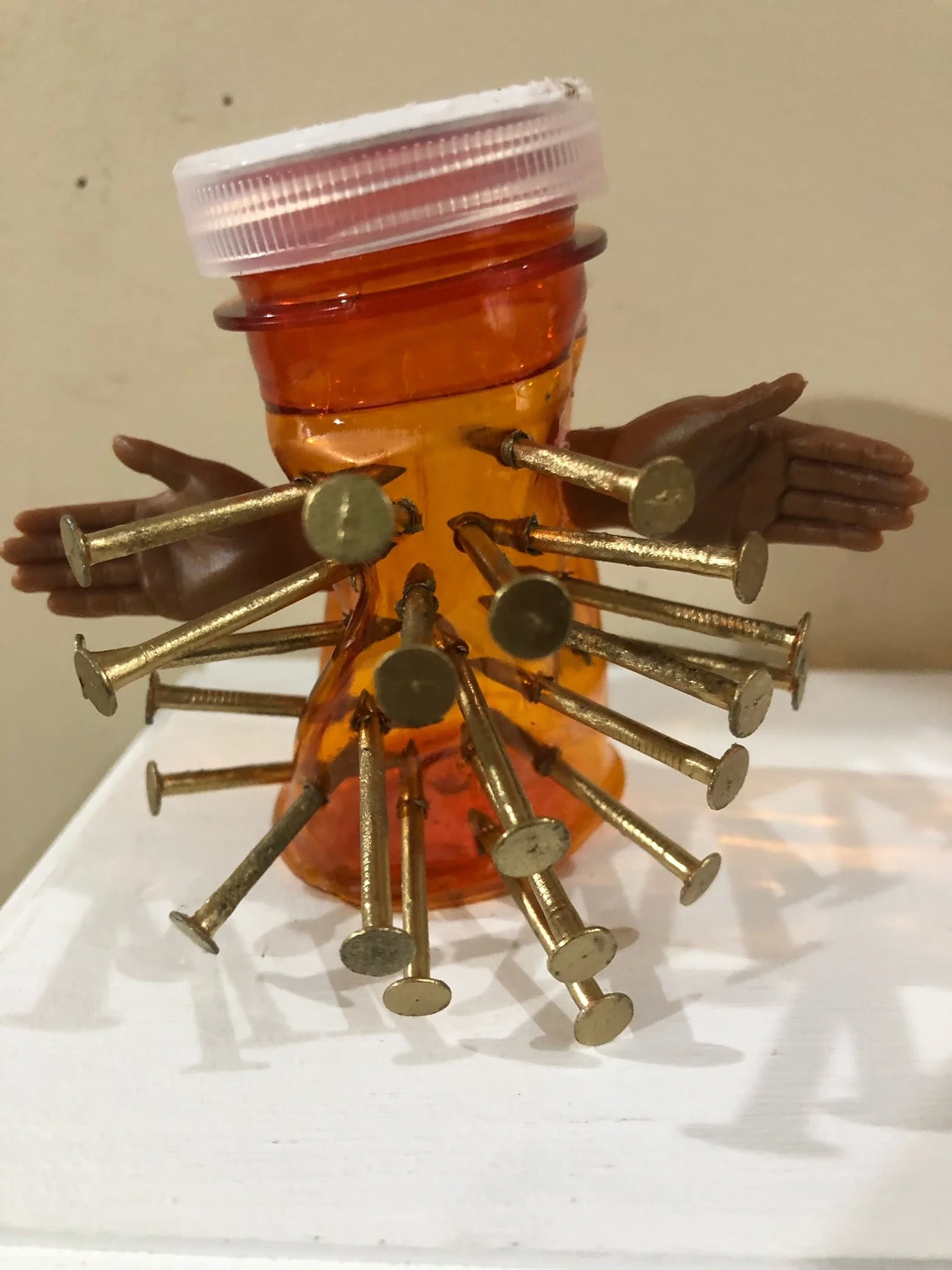
IMAGE DESCRIPTION: prescription bottle, gold painted nails, rubber doll hands, 2020, 3.25” x 3” x 2”
A melted prescription bottle has two small brown hands extending out on each side. In the front of the bottle, it is punctured by 21 gold colored nails.
SIDE EFFECTS SERIES (LOBOTOMIZED PAIR)
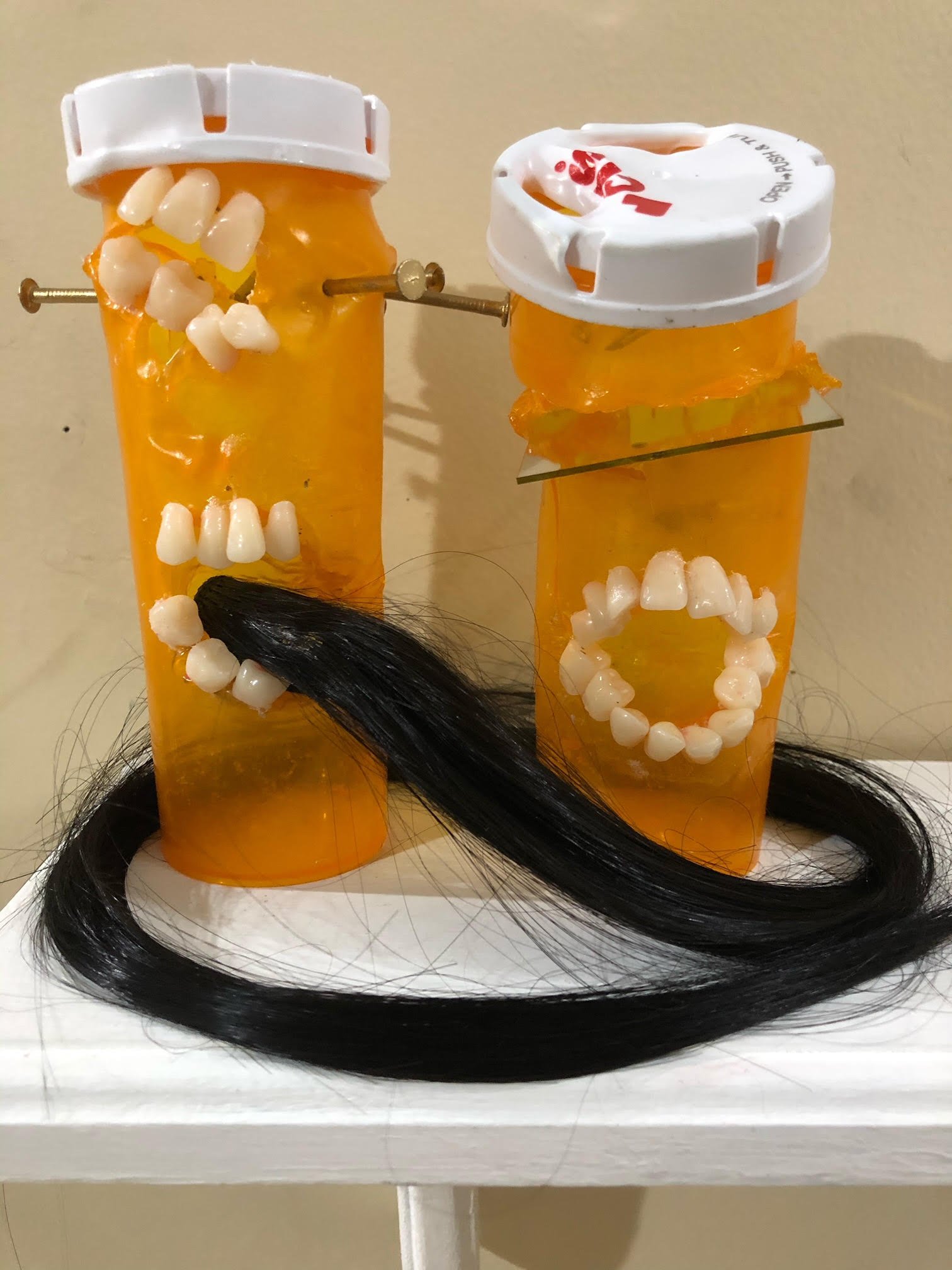
IMAGE DESCRIPTION: prescription bottles, resin teeth, synthetic hair, nails, mirror, 2020, 4” x 4” x 3”
Two prescription bottles. The one on the left bares resin teeth that jut out. Near the white cap are nails that puncture the bottle. Towards the bottom long hair emerges from a mouth like orifice that wraps around the second bottle. The bottle on the right also bares resin teeth, but instead of nails near the top a small square mirror cuts into the bottle.
SIDE EFFECTS SERIES (IN PLACE OF SUTURES)
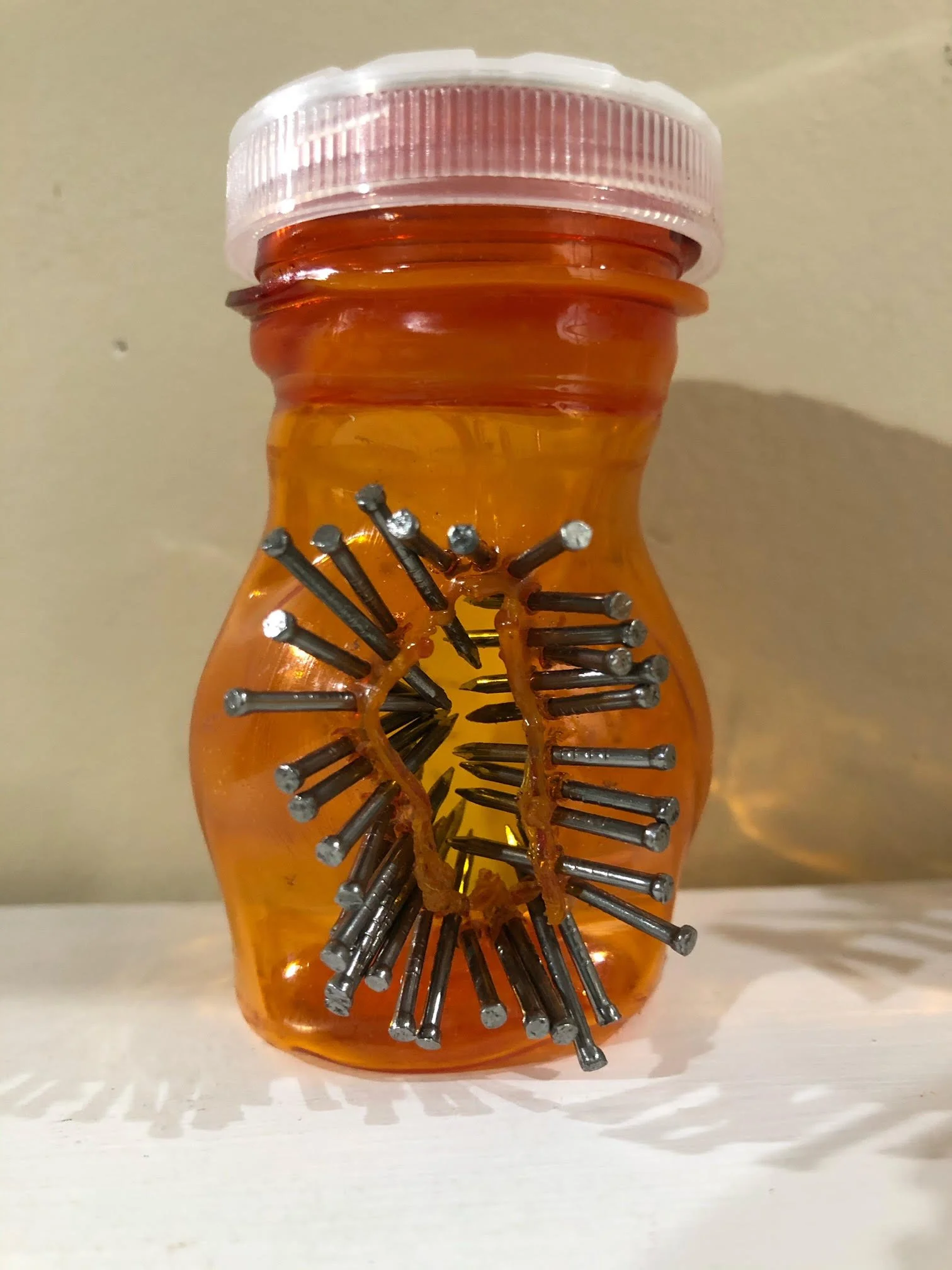
IMAGE DESCRIPTION: prescription bottle, nails, 2020, 3.25” x 2” x 1.5”
Prescription bottle torn open to reveal a vertical gaping hole with 33 nails puncturing along the edges of its skin.
Artist statement:
My interdisciplinary practice focuses on the diversity of the lived experience of mental health difference, and the impact of the stigma,inequity of care access and discrimination. This body of work developed based on my personal experiences as someone who was diagnosed with bipolar disorder as a way to grasp and translate their meaning through the lens of disability justice and mad pride. I utilize an archive of medication guides, prescription bottles, historical and psychiatric resource materials, and medical texts that reflect mental health conditions and systemic and historical legacies to find strength in vulnerability.
I manipulate prescription bottles as markers of maintenance of my condition of bipolar disorder and its stigma to remake them into sculptures. Easily identified by their childproof caps and amber colored plastic, the bottles do not reflect the escalation of cost, inaccessibility, and side effects. I transform them as I play with the scale to magnify and make visible the embodiment of the condition and its contradictions. Side effects, torment of the condition and the spectrum of emotions are revealed through puncturing, melting, pulling, and embellishing the prescription bottles.
This is an extension of my continued interest to apply personal narrative as a way to share experiences to disrupt stereotypes, create safe spaces, and to reflect on neurodiversity, contemporary issues and an intersectional identity through installation, multimedia, video and performative actions and ultimately to make the invisible visible and animate the inanimate.
Cynthia Bargar
IMPETUOUS TENDENCIES
Patient became excited, preoccupied with sexual thoughts & denudative.
— author’s patient file, Glenside Hospital
The American Journal of Insanity circa 1905 says:
we place satyrs & nymphomaniacs
immediately after the imbecile
& feeble of intellect.
However impetuous
be the tendencies,
the intelligence — if it is normal
— governs & restrains them.
A woman — her lascivious bearing,
provocative movements,
amorous utterances,
— falls to the level of the animal.
Her intellect neither reigns
nor governs.
Cameron Morse
PIECE OF MIND
Completely shattered
Any bible verses, books, etc.
helped get somewhat of
a piece of mind?
Still am picking up
the pieces of my mind
*
Squished like a runaway
grape a rollup
mattress
*
fab lab
18 WOOD WHEEL PCS
For indoor decorative purposes only
If I only knew what
my purpose was
if life was
more than feeling fab
lab rat
*
Shaking suds
out of my yellow
sponge in the dark wok
water, nonstick
sticking to me
this celebration of
life is also
death’s kazoo a
DEAD END & the railroad
spikes we carry home
from the tracks
*
Don’t step on the ice walk
on the rocks
That helps the helpless father
figure prefigured
by my father before me
*
Inoperable, methylated wild
type GBM
reckless bombardier
wild blueberries smeared
on the faces of
my children
invented the yogurt
moustache
Kim Michalak
MISOPROSTOL
Three white tabs pressed against
my bottom gums, the only drug
I’ve taken this way, another first
Alone on the couch with just the dog
as company, I wait for the bottom
to drop out, debris in a yolk sac
of the wrong genetic combination
a melancholy accordion of DNA
not suitable for life anymore
The cramping begins with the hour
and I suit up in armor of heating
pads and blankets, soldiers Ben & Jerry,
and the hard stuff, too, Oxycodone
just in case it’s unbearable
The dog inches nearer, resting
his head on my womb; the unknown
web pages and message boards
suggest that the worst will be over
in 2-5 hours, but I know better
I am prepared for all the blood,
the sharp cries from my abdomen,
and the sudden emptiness, but
I am not prepared to see it
called an “abortion drug”
as if the classification canceled
out my desire for this baby
that will never be
Samuel Ugbechie
MORE THAN A FLOOD
Rain fell last night. This morning, floods scourge
the city, waters wash the buildings down. And down
the market square, a vein of kiosks is split open.
Roofs are sore like a burr of inflamed tongues,
and the shed—the slanted shadow that once shaded
us—bends like a canted neck, a gush of water
pushing phlegm out of its mouth. I stand here
with you: a flood survivor, watching residents—
knee-deep in the water—splash all their fears
and sprinkle a thousand gossips on pulses
made of mud. Tongue to tongue, ear to ear, they pull
their burdens away, while your palm holds mine
and braids my veins and tells my bones you’ve been
here before. Your flood, though, was different.
It was familial and human. It was not a flood,
but it flooded your childhood. First, a whoosh
the edge of your father’s fist. Then the ink
on a divorce paper—the deluge written with a pen—
pitting your father’s name against your mom’s,
drowning your home, snuffing their hugs off the paper
-backs of your skin, ripping out every touch that once
hewed their kisses on your body. Who knows
why floods invade us? Who knows why our lives,
like roads, are beaten like a city-size teapot:
full, sitting on a burner of disappointment? The residents
have lost a handful of kiosks and stores, but none
have lost a family like you: standing still, looking
at hope inside this wild, mild, tender flood, and tightening
your palm on mine, and walking as though pulling me
out of the water, out of the flood—knee-high, soul-deep—
unlike the way it was when you were 8, left all alone,
walking yourself all by yourself, out of your flood,
without a hand to pull you through. Tell me how
you sniffed above water. Tell me how you pulled
ahead of drowning. Tell me what scars and tissues
make our survivals worth it. Silence. A shuffle of tiptoes.
A pair of damp shoes: the way your soul felt, lost
in its camp, screaming helplessly on the flood
-washed sand.
Pamela Hobart Carter
I SHED MY HATE
after “I Save My Love” by Marjorie Saiser
I shed my hate for what lies distant,
for the rude man, professor of literature,
when I replay the unasked kiss
dropped on my head. I shed
my hate for the sips from Greek diner cups,
at his behest—as obediently undertaken
as an assignment. He argued, no academic
should dislike coffee. His wide dark desk
between us. No place to rinse
astringence from my tongue. I shed my hate
for what stayed. The lewd stare
his eyes ran over my sweater, my hand
reaching for the doorknob.
The look lasts, painted like an oil over a sketch,
his, “You have a nice body,” the name of the work.
His voice, tinted by his native Russian,
in forest colors—olives, siennas, madders,
I loved to see in the wild on the other side
of his office glass, him gazing at the teenager.
The teenager gazing at the trees.
Issue 75 Contributors
Cynthia Bargar is thrilled that Rogue Agent chose to publish two of her poems, one in Issue 74 and this one in Issue 75. Her poems have appeared in Book of Matches, LUMINA, Comstock Review, Driftwood Press, Stoneboat Literary Journal, Poems2Go, and other journals. Her debut collection, Sleeping in the Dead Girl's Room, is forthcoming from Lily Poetry Review Books in 2022. Cynthia lives and writes in Provincetown, Massachusetts.
Adrienne Burris is a writer/teacher based in Greenville, SC. Her poetry appears or is forthcoming in Washington Square Review, Mum Poem Press, and Free Verse Revolution, among others.
Pamela Hobart Carter used to be a teacher who wrote on the side. Now she is a writer who teaches on the side. Her plays have been produced and read in Seattle (her home), Montreal (where she grew up), and Fort Worth (where she has only visited). Her chapbooks: Her Imaginary Museum (Kelsay Books, 2020) and Held Together with Tape and Glue (forthcoming from Finishing Line Press, 2021). Find out more about Carter at https://playwrightpam.wordpress.com/.
Terhi K. Cherry is a poet, writer, and research psychologist. Her poems have appeared or are forthcoming in Literary Mama, the Un(mother) film and anthology, Cultural Weekly, Vox Viola Literary Magazine, and elsewhere. Terhi lives in Los Angeles and facilitates poetry for personal growth. Find her on the web at terhikcherry.com .
Kim Michalak is a Florida-based poet, mother, and optical stylist. She received an MFA in Creative Writing from Chatham University and serves as associate poetry editor at The Fourth River. Her work has been published or is forthcoming in Literary Mama, Global Poemic, Briefly Zine, Brushing, and Snapdragon: A Journal of Art & Healing.
Cameron Morse is Senior Reviews editor at Harbor Review, a poetry editor at Harbor Editions, and the author of six collections of poetry. His first, Fall Risk, won Glass Lyre Press’s 2018 Best Book Award. His latest is Far Other (Woodley Press, 2020). He holds and MFA from the University of Kansas City—Missouri and lives in Independence, Missouri, with his wife Lili and two children. For more information, check out his Facebook page or website.
Jessica Poli is the author of four chapbooks and co-editor of the collection More in Time: A Tribute to Ted Kooser (University of Nebraska Press, 2021). Her work has appeared in Best New Poets, Southern Indiana Review, The Adroit Journal, and Redivider, among other places. She is a PhD student at the University of Nebraska-Lincoln, founder and editor of Birdfeast, and Assistant Poetry Editor of Prairie Schooner.
Sara Quinn Rivara is the author of two collections, ANIMAL BRIDE (Tinderbox Editions, 2019) and LAKE EFFECT (Aldrich Press, 2013). Her work has appeared recently or is forthcoming in Mom Egg Review, Indianapolis Review, Colorado Review, West Trestle, Whale Road Review and elsewhere. She lives in the Pacific Northwest with her family.
Lannie Stabile (she/her) is the winner of OutWrite’s 2020 Chapbook Competition in Poetry; the winning chapbook, Strange Furniture, is out with Neon Hemlock Press. She is also a back-to-back finalist for the 2019/2020 and 2020/2021 Glass Chapbook Series and back-to-back semifinalist for the Button Poetry 2018 and 2019 Chapbook Contests. Find her on Twitter @LannieStabile.
Chanika Svetvilas is an interdisciplinary artist who utilizes lived experience to create safe spaces, to disrupt stereotypes and to reflect on contemporary issues. She has presented her interdisciplinary work nationally in multiple spaces and contexts. Her work is also included in Studying Disability Arts and Culture: An Introduction by Petra Kuppers and NuyorAsian Anthology edited by Bino Realuyo. She holds a BS from Skidmore College and an MFA in Interdisciplinary Arts from Goddard College. She is a co-juror for the West Windsor Arts Council’s upcoming fall art exhibition, Well-Being Ourselves: Reflect, Reimagine, Connect. Find her on the web at chanikasvetvilas.com and on Instagram at @chanikasvetvilas.
Samuel Ugbechie has works published or forthcoming in Ruminate Magazine, Palette Poetry, Nottingham Review, and elsewhere. His poetry collection, Monologue of Fire, won the Many Voices Project Prize from the New Rivers Press. It will be published in book form in 2021. He’s the winner of the 2020 Aurora Poetry Winter Contest, the 2016 Frederick Holland Poetry Collection. His works have been recognized in awards like the Vice-Chancellor’s International Poetry Prize, the Into the Void Poetry Prize, and others. He tweets @sugbechie.