
IMAGE DESCRIPTION: The image is a small digital collage located in the lower left space of the “canvas.” It features a broken picture frame with a picture of a woman in a mirror hanging out of it. Peeking out from behind the right of the frame is a square of gray stars in a darker gray background. The frame is covered in green vines on the top and left, with a glowing lily dangling off the bottom left corner. Rising out of the top of the frame is a handprint in silhouette, a gray cloud, and a small flock of birds. Behind the frame are black paint spatters and pink lens flares.
ISSUE 92
CONTENTS
NOVEMBER 2022
Melanie Figg
Nathaniel Rosenthalis
Thomas Mixon
Wendy Mannis Scher
Auzin
ART: Shloka Shankar and Robin Smith
Saga Savage
Diana Whitney
Subhaga Crystal Bacon
Sarah Sassoon
Robert Guzikowski
CONTRIBUTORS
Melanie Figg
FIRST BIKE RIDE
My sister’s blue
three speed had
a white rear fender
flat enough
for me to sit on.
I held on tight.
Her body was all
I could see
ahead of me and
the blurry sides,
the ground so fast.
At the top of the hill
we dropped and
the speed made her
hair fan my face,
the speed made
me scream. I looked
down and watched
my left foot meet
the spokes. I screamed
with the speed of it
winding my sneaker
into a spiral. I screamed
at the easy cutting of the wheel
and the wonder of watching.
And my sister
she thought
I was still screaming
for the blur of houses
and trees passing,
for the thrill of her
attention.
Nathaniel Rosenthalis
MACHOVILLE XXI
You pulled off your torso with the thumb and finger.
You looked like the construction of men in orange vests wiping their foreheads with the soft backs of gloves. You could get far, not ever being that material you’d come for.
Compare that inch you pinched to the superior packets of artificial sugar you wanted to be to him. Not to last forever. Not to be stored. Not to insist on your digestibility. Not to back the back of his tongue you pulled on, with your tongue, so the spaces widen between syllables. Not to work a caustic clause. Not to miss him and become him. Not to sweeten your increase. Not to confuse the backwaters you were coming from for all salinity.
Thomas Mixon
CUT TIME
The linings of my innards’ out
numbered days are counted
by each hair. That I am over
reacting, is obvious, but in
cidental to my body’s dooms
day clock, that winds itself
around the withered villi,
cadential, commoning it
self into a 4/4 beat, familiar
stresses. I am used to
malabsorption’s stasis,
the nutrients bewild
ered by tempus imperfectum,
immobile till they’re alla
breve’d through. At last
tally, the endoscopy’s
results are inconclusive
tempo markings bloated
all across the staves.
Wendy Mannis Scher
SOMETHING I WANT TO SHOW YOU
my chest is numb, bound where breasts once lived, under armpits, over ribs. Numb as if surgery’s nerve block never wore off. I wear cotton, dream burlap, spiders, textured pelts. You promised you wouldn’t mind the loss, misshapen breastlessness, the photos doctors showed us. Skin-to-skin, not for 2 years. Are you numb? Are we numb together? Do you itch? Scars itch, crave fingers, nails across pale ripples. Gum-rubbery, I stretch, circle arms, a lightning rod, an old TV antenna searching for signal. Sometimes pain/flesh sears split-second clarity. At night, I belly-sleep, chest pressed against the mattress, a drought-flattened aster, late summer tinder. I ache. I want. I’m numb. I’m not; prick me—here . . . here . . . here.
Auzin
COPPER BLOOD / SILICON VEINS
After David Cronenberg
let’s stay paranoid &
after a few decades
they’ll call us prophets
freshborn skin crawls over eyesockets
muscle unspools from novel orifice
& creamy bone spurs ride my skull
you know the body was the first machine
there’s a hundred ways to talk about flesh &
tell me, is this protrusion or intrusion
tell me, which animal do you fear the most
tell me, is there a place I can wake up
where the electrical impulses inside me
don’t connect to RCA ports
my optic nerves
no longer a cathode ray breeding ground
& it won’t smell like torched plastic when I cry
my pleasure & my pain forgetting each other
Shloka Shankar and Robin Smith
HAIGA 1
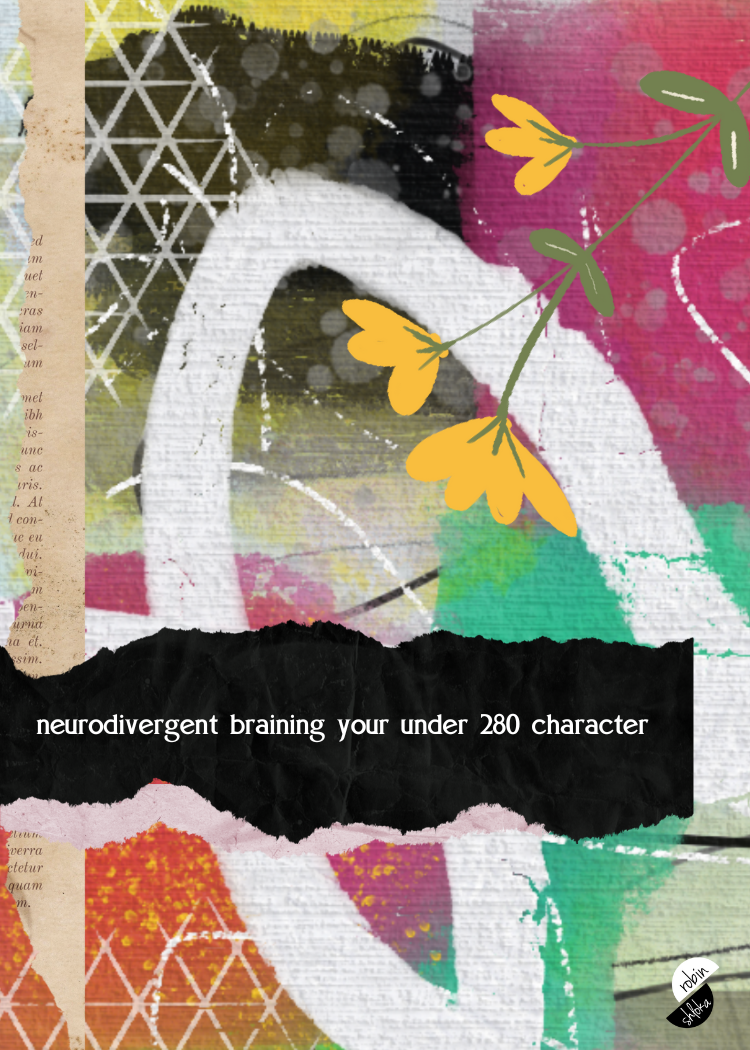
IMAGE DESCRIPTION: An Artist Trading Card haiga, measuring 2.5 x 3.5 inches. This is a digital multi-media collage. The abstract background is a mix of black, white, dark pink, green, and orange colours in blocks, containing both organic and geometric shapes. Paper scraps and other botanical ephemera (yellow flowers) are arranged around the poem. The text of the haiga reads “neurodivergent braining your under 280 character.”
HAIGA 2
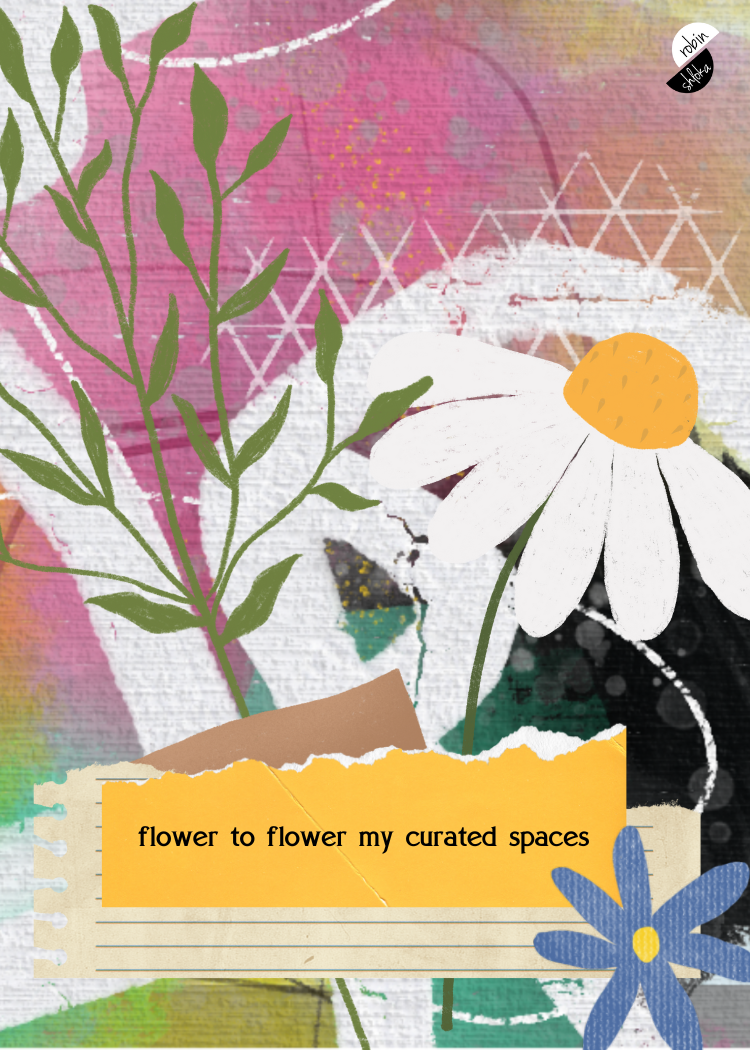
IMAGE DESCRIPTION: An Artist Trading Card haiga, measuring 2.5 x 3.5 inches. This is a digital multi-media collage. The abstract background is a mix of black, white, muted pink, and hints of yellow and green. Paper scraps, flowers, and other botanical ephemera are arranged around the poem. The text of the haiga reads “flower to flower my curated spaces.”
HAIGA 3
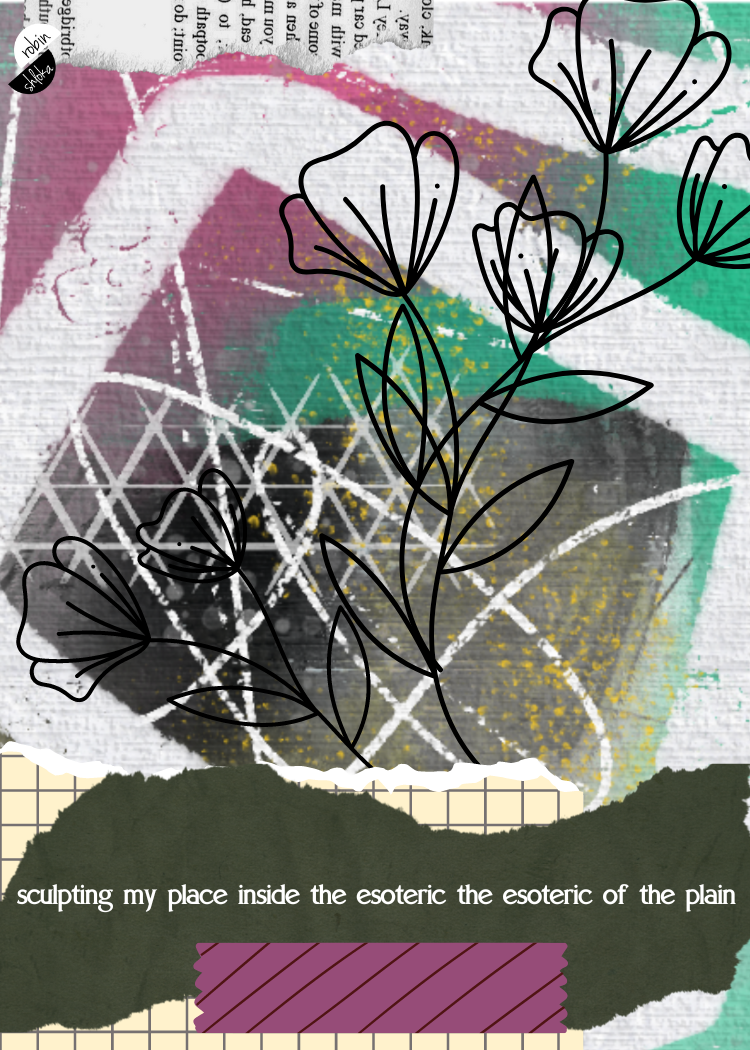
IMAGE DESCRIPTION: An Artist Trading Card haiga, measuring 2.5 x 3.5 inches. This is a digital multi-media collage. The abstract background is a mix of pink, green, and bold brush strokes in white that mimic a geometric pattern. Paper scraps, tape, and a line drawing of flowers in black are arranged around the poem. The text of the haiga reads “sculpting my place inside the esoteric the esoteric of the plain.”
Artist statement:
This set of digital Artist Trading Cards (ATCs) came about as the result of an experiment I tried using the apps Infinite Painter and Canva. I masked off a large digital canvas into six rectangles and later cropped each individual section to create unique abstract backgrounds. Robin then went on to add the haiku and ephemera to each card using Canva. The haiku sequence explores the shortcomings of social media, particularly Twitter, with its character constraint that makes it hard for neurodivergent folx to communicate effectively. We are both disabled poets/artists living with chronic pain.
Saga Savage
TRICHOTILLOMANIA
I pull my eyelashes
from my head and collect
them in buckets, keep them
hidden under my bed—
I wish I could glue them together,
fashion clusters into seeds,
build the world’s largest dandelion;
I would blow it all away—
send bulbs and stalks to grow
new versions of myself
in all the world’s cracks, let me
start again—give up these shaky hands
and rabbit heart—trade them in
for parts of me grown in hollows
of trees, the furnaces
of volcanos, the depths
of the oceans—
born new with a full set of teeth,
able to {re}construct myself—
transmute me into gold.
Diana Whitney
ATTRIBUTION ERROR: AN ABECEDARIAN
after S. Erin Batiste
Because the girl is abandoned, acting like an animal, always assuming the worst
Because the girl is bruised and blooming at the same time, rumored to be good at blowjobs, in possession of a body
Because the girl is capricious, clad in candy necklaces, a common whore
Because the girl is drinking, dancing with her arms in the air, deficient in perception
Because the girl is emotional, enthralled with extremes
Because the girl is feral, frustrating you with her fluid identities
Because the girl is growing up fast, getting off in a graveyard of sin
Because the girl is headstrong, heedless of how she looks in a halter-top
Because the girl is isolated, infamous for her issues
Because the girl is jaded, on a crying jag, can’t take a joke
Because the girl is kinky, keen for new experience
Because the girl is lying, a perpetual lapse of judgment, languid as a sigh
Because the girl is moody, wearing too much makeup, often mistaken for a muse
Because the girl is a nymph, nameless in her natural habitat
Because the girl is obedient, opening her mouth for approval
Because the girl is pretty, sneaking pills at parties, pierced all over and obviously perverted
Because the girl is quick-witted, an open question
Because the girl is ready, a mess of raw material, craving romance
Because the girl is smiling, slipping out on summer nights, a shadow of a self
Because the girl is tragic, prone to throwing tantrums, tattooed like a tramp
Because the girl is uncertain, eager to be useful
Because the girl is vulnerable, said to be a virgin, her gaze evading yours
Because the girl is wasted, waking from a nightmare, worn down to the bone
Because the girl is the x-factor, cipher of sex and anxiety
Because the girl is yearning, younger than you realized
Because the girl is zealous, unzipping her zone of protection, she’s asking for whatever she gets
Subhaga Crystal Bacon
IS THERE A NOUN CALLED DISRUPTURE?
This morning, as I lay on my bed doing PT,
I was rewarded with a glimpse of marbled sky
under the eaves. I focused on one striation, rupture
of texture. I saw even this little view as a gift—
it holds every walk I’ve taken here, suspended now.
I’m puckered up as for a kiss, but the lips
are on my thigh. Twin scars—Romantic! Oh,
that’s usually stars—embrace my leg. Who
will kiss away the tape, black with lint
though clean. Paula, the tele- nurse responsible
for me says to let it be. The stitches are inside
and will dissolve. I’m held together with dried
blood and sticky stuff. Don’t cross your legs
or bend more than ninety degrees she says.
I’ve sweated through two undershirts a night
the last three days, weaning myself from a week
of oxycodone. I wake as if weeping through skin,
hair dripping. I’m exuding rivulets. What is it?
So much more than sweat. I chew cannabis sweets
throughout the day. They sawed me open, cut
bone, and pulled out defective hardware meant to fix me.
Then fixed me again. Disrupted my texture:
scalpel, saw blade, drill, wire, suture. Closed.
Sarah Sassoon
LET US TALK ABOUT THE BLOOD
What is this blood
my son screams
The dog drags bloodied beaten
cotton from the bathroom bin
into the lounge
up the stairs
ravished entrails of ripped
ruined tampons
How do I explain
his mother’s blood
all that bleeds
My mother handed me a book
like she felt nothing
my grandmother asked me if it hurt
I want to tell her it hurts like hell
but she’s gone
Something’s dead
I want to look into my son’s bright eyes
and say
be a man who respects blood
Robert Guzikowski
APHASIA POEM 23
somatic ecstasy
falls free of asymmetric neural
gravity, uses convolutions
of earthly inertia
to reach escape velocity, to
free fall in the vacuum of desire.
this rhapsody of
inarticulation, this spasm
of wordless chaotic unity
overtakes direction,
overtakes speed, overtakes time for
a weightless instant of curvature.
bodies breathing words and empty space,
transit veiled hemispheres out of place
Issue 92 Contributors
Auzin is a writer from the Pacific Northwest who strings words together because there are creations inside her which clamor to get out. She has published with Nowruz Journal, Rogue Agent Journal, and Agapanthus Collective. She is the former Managing Editor at Hecate Magazine and a current submissions reader for The Jupiter Review. Her work can be found at byauzin.com.
Subhaga Crystal Bacon’s new book, Transitory, has been selected for the Isabella Gardner Award and is forthcoming in the fall of 2023 from BOA Editions. A fourth collection, Surrender of Water in Hidden Places won the Red Flag Chapbook Prize and is forthcoming in the spring of ‘23. She’s the author of two previous collections, Blue Hunger, 2020, Methow Press, and Elegy with a Glass of Whiskey, BOA Editions, 2004. A Queer Elder, she lives, writes, and teaches rural northcentral Washington. Her recent work appears or is forthcoming in 45th Parallel, The Indianapolis Review, Rise Up Review, Wood Cat Review, Wild Roof Journal, and The Meadowlark Review.
Melanie Figg’s collection, Trace, was named one of the Best Indie Poetry Books of the Year by Kirkus Reviews. Her work has received grants from the National Endowment for the Arts, MD State Arts Council, and others and been published in dozens of journals including The Iowa Review, Nimrod, The Rumpus, and the American Journal of Poetry. As a certified professional coach, she teaches writing, offers women’s writing retreats, and works 1-1 with writers. More at www.melaniefigg.net.
Robert Guzikowski published work in the 1970’s and 80’s in several magazines and co-edited The Parlor City Review. In the 1990’s he had encephalitis which caused brain damage. Aphasia was one of the sequelae. He has resumed writing poetry and some of these poems have been published or are upcoming in Kissing Dynamite, The Raw Art Review and Wild Roof Journal.
Thomas Mixon has poetry and fiction in Lover's Eye Press, Grim & Gilded, At Length, The Broadkill Review, and elsewhere.
Nathaniel Rosenthalis is an actor, singer, and poet. He is the author of the forthcoming I Won't Begin Again (Burnside Review Press 2023), winner of the 2021 Burnside Review Press Book Award selected by Sommer Browning, and The Leniad (Broken Sleep Books 2023) and of three chapbooks, including 24 Hour Air (PANK Books, 2022). He lives in New York City, where he occasionally teaches writing at NYU and Columbia University. More info can be found at www.nathanielrosenthalis.com.
Sarah Sassoon is a writer and poet of Iraqi-Jewish descent. Her work has appeared in the Michigan Quarterly Review, Ruminate, Lilith, The Ilanot Review and elsewhere. She is the recipient of the Andrea Moriah Poetry Prize, and her micro-chapbook, This is Why We Don’t Look Back was recently awarded first place in Harbor Review’s Jewish Women's poetry prize. Sarah is also the author of the children’s picture book, “Shoham’s Bangle” (Kar-Ben Publishing). Visit www.sarahsassoon.com.
Saga Savage (she/they) is a queer, disabled poet. She earned her MFA from Oklahoma State University. Saga's current work focuses on disability, neurodivergence, trauma, and witchcraft. She is an editor at Glass Pen and previously held an array of editor positions at Cimarron Review, Cleaver Magazine, and New Plains Review. Her work has appeared or is forthcoming in Witch Craft Mag, Rust + Moth, Petrichor, and The Central Dissent.
Wendy Mannis Scher, a graduate of Smith College, the University of Colorado’s School of Pharmacy, and the Low Residency MFA program for Creative Writing/Poetry at the University of Alaska/Anchorage, lives in Colorado’s Front Range. Her poems most recently have been published in Gyroscope Review, the chapbook, Fault (Finishing Line Press) and the anthology Thought for Food. For additional information, please visit www.wendymscher.com.
Shloka Shankar is a poet and self-taught visual artist from Bangalore, India. A Best of the Net nominee and award-winning haiku poet, Shloka is the Founding Editor of the literary & arts journal Sonic Boom and its imprint Yavanika Press. She is the author of the microchap Points of Arrival (Origami Poems Project, 2021) and her debut full-length haiku collection, The Field of Why (Yavanika Press, 2022). Website: www.shlokashankar.com.
Robin Smith listens for voices in the wind, the grass, the birds . . . and relays it via the pen, the ink, the paint. Co-founder & Co-editor of whiptail: journal of the single-line poem, and Associate Editor at Sonic Boom and Yavanika Press.
Diana Whitney writes across the genres in Vermont with a focus on feminism, sexuality, and motherhood. She is editor of the bestselling anthology You Don’t Have to Be Everything: Poems for Girls Becoming Themselves, a Best Book of 2021 and winner of the 2022 Claudia Lewis Award. Her writing has appeared in The New York Times, The Kenyon Review, Glamour, Tinderbox, and many more. She works as an editor and writing coach. More at www.diana-whitney.com.