
IMAGE DESCRIPTION: This digital collage has a mottled blue and purple background with several patterns in it resembling cross-hatching, bandages, duct tape, and stitches. A woman with pale skin, naked except for shoes, appears to be wrapped upside down into the fabric of the background. Only her legs and arms are showing. Her left palm is on her belly and her right arm reaches downward.
ISSUE 102
CONTENTS
SEPTEMBER 2023
Monique Quintana
Vanessa Couto Johnson
Kristin Camitta Zimet
Jillian Clasky
Lisa Marie Oliver
ART: Simone Stoll
Yael Valencia Aldana
Jen Karetnick
Anne Champion
Fox Henry Frazier
Lorelei Bacht
CONTRIBUTORS
Monique Quintana
COLD HOUSE: A SPACE OPERA IN FIVE ACTS
Knowing what I know now of harps, I commission the dolphins to play them until you arrive. Knowing what I know now of turpentine, I commission the dolphins to paint a hollow apple brined with kelp, a gesture to bring us the brink of forgiving. It's not safe to swim there. It's not safe to swim there. It's not safe to swim there? It is not safe to swim here. Turn back until the music stops. Until it stays lodged in your throat like the taste of forbearance, like the taste of negative balance. Don't forget how hard it used to be before you knew of their existence, of their wailing seeds to place where saltwater meets freshwater, like a star core.
My sister makes her dress fly to pick berries and talk to her lover at the same time. Our ancestors interrupt us to say they don't want us to multitask but to focus on one thing at a time. I go over these rules repeatedly as I pluck the rest of our meal out of root water. We are both self-centered to pass the quiz and hover over the bubble of our love. I want to build a house for the two of us, but then again, wandering can be good for us as we carry our bowls past the vapor to hear roaches harp beautifully. We use to revile them, but now we treat them as almost deities, knowing how indestructible they are. If only we could live so small and so tender.
Gunning to make a soup that will last until spring comes, my father prides himself on the fact that that the brown man in the Donner Party refused to eat flesh. This is where I always start first, with the boys in my house. Oh, bone, how do you transform into iron shoots? How does your heart pump faster than the fish swim at night when the snowfall reaches its coldest peak? The whole lot of them was forsaken because of the Mexican War, and here we have a war with ourselves.
There's a reoccurring story of my mother and your mother and their mother hitchhiking and getting conned. We still let the stars trick out of loving each other with milk. The value of their clay cups has gone up in this store. We find their belongings on the shelves. We make a mockery of all it knows, placing their ache in cold plastic baskets, rocking to the sound of tangerine fuel and coin exchange machines. Each piece of silver features their faces, each face in a plastic bubble. We shake them and begin to recognize ourselves. The way our hair grows amends.
I buy the cold leather cuffs to wrap around the hair I cut off. They float there in the empty space because my hair is gone. In that zero space, there are clouds hungry for caves to hide from people. We're clouds now, separated from each other. If you were to meditate on my stubbornness, what number would you land on? Where would you pin the tail on the donkey? Our animals bray at night to help us find our way back from tiny gestures. Idols try to soothe me to sleep to no avail. I ponder my family's racetrack horses. With open palms now, I try to pull the grain from the bucket to feed, but it keeps falling out like dust.
Vanessa Couto Johnson
r(St_Etch)
Can’t reach
every potential. My canine
keeps getting me every time
I’ve got a new spoon from the pot.
Lump for my mouth
to heal. Taste for my tea
-se to br[uise|ews], water to turgid.
Os-
more
-gularity
says flaccid fine sometimes and I understand
it happens to lots of cells’
self-care.
Kristin Camitta Zimet
XRAYS
Stand, sit, lie down: in 37 shots, they catalog
your boneyard body, chalk up its palisade,
its scarecrow joinery, tower of pickup sticks
in which you play, tissues almost invisible:
a ghost envelope, an outbreath on the film.
Too much and too little, proofs hang in
a twilight box. Click on click, they turn you
inside out, catching and missing everything:
what the marrow of you cradles in plasma,
inmost ocean, past opacity, past possibility
of myeloma, your salt center giving, giving,
birthing and birthing love, taking the hurt
of every body’s brittle incarnation. Without
instrument I see your true your mothering
spirit surely whole and holding home.
Jillian Clasky
REMOVALS
Fifty in a row and each cracks an egg into a bowl our shoulders can hardly reach, pairs it with flour and yeast and honey, kneads the dough with bare hands. I remember the cold, my fingers slick with the remains of a birth that would never be. I tried to pretend it was soap: clean as ice, stripping the dirt and grime and bacteria from my skin, making me new. But even after the ingredients were blended, after we rolled our dough into strands and braided them together, I felt the egg digging into the spaces under my nails, into the lines that latticed my palms. We glazed our challahs, strew them with sesame seeds, and let the teachers cart them away; we were too young and too many to operate the ovens. At the end of the day, they handed out our finished creations haphazardly. The challah I received but did not make was misshapen, the plaits all different widths, the seeds scattered in an uneven pattern. I never understood why the only blessing we’re commanded to say before each meal—the blessing Jews more conscientious than me recite three times a day—is the blessing over the bread, which is said to include, if not in its language then by extension, all other parts of the meal. As if bread alone could satiate, could imbue us with some sacred quality of wholeness; as if a meal without bread were incomplete, or at least not as soft to the touch. At eight years old I brought my challah home, placed it on the kitchen counter, and lathered furiously to wash my hands of the memory, but the soap turned into a cracked egg in my palms, gelatinous and impossible to hold. Still I watched it foam, let the suds leak down the drain; I pressed a damp finger to my wrist, felt a flutter of a pulse, felt myself turn cold, felt the blood in my veins coagulate; I swallowed the whole loaf at once to make it disappear.
Lisa Marie Oliver
BROKEN DUPLEX WITH DORMANT CINDER CONE
Part of the cinder cone has been cut away:
ash, volcanic clinkers, dark moonscape,
night moonscape, don’t let me forget, we held
hands at the conical hill, new lovers.
Anyone could tell we were new lovers, how we
touched arms, wrists, shoulders, vertebrae.
how you touched my necklace, don’t let me forget.
When I told you about cinder cones
you said only four in the city, when I told you
about ash, grief, missing, everyone
could tell we were new lovers. Missing you
I wrote these poems about death
thinking I might die soon after. Not saved
by love, not by family, by my kid, not friends,
not God. Just poetry, that saved. Don’t let me
forget. The cinder cone, the cutting away.
Simone Stoll
INSIDE 1
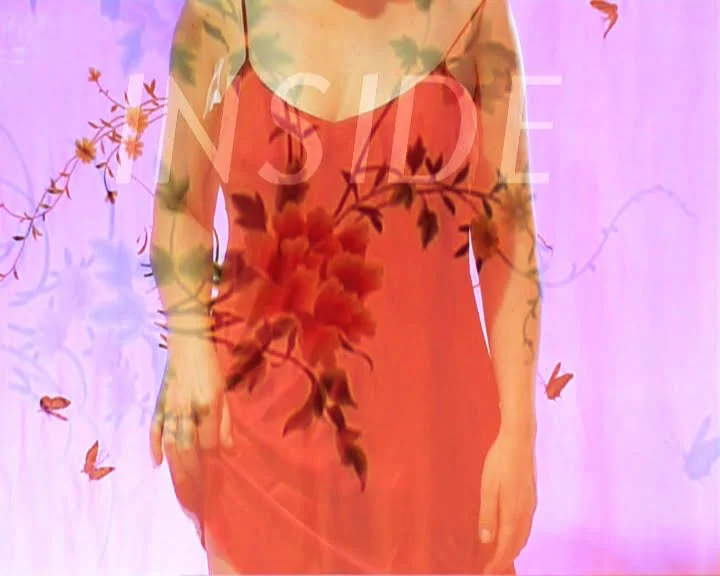
IMAGE DESCRIPTION: The image has a lavender background, perhaps a curtain, with blue shadows of vines and leaves. Superimposed on the lavender curtain is a woman’s torso in a red slip dress down to her thighs. Her left arm hangs loosely at her side. Her right hand clutches the fabric of her dress and pulls up the hem to reveal a small glimpse at her thigh. The shadows of leaves and branches creep over her pale arms. A bouquet of red flowers is layered over her right ribcage area. Layered across the woman’s chest is the word INSIDE in all caps. The whole image feels gauzy, ghostly, and soft.
INSIDE 2
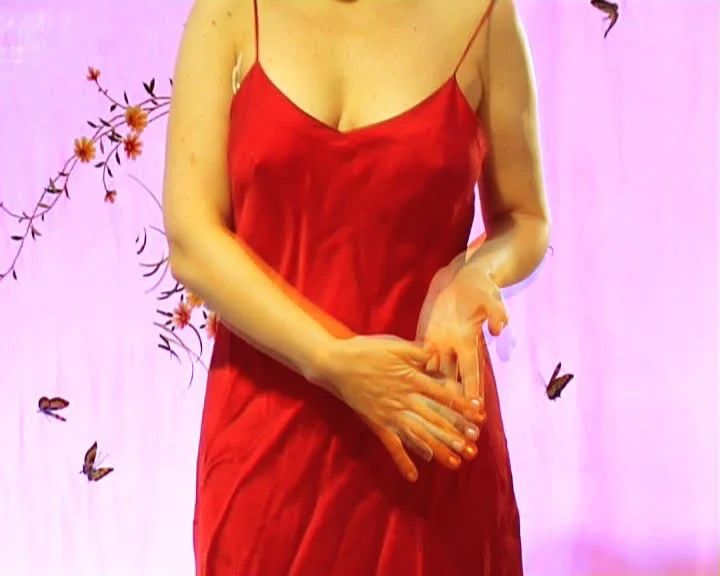
IMAGE DESCRIPTION: A femme in a red nightgown with spaghetti straps is shown from shoulders to hips. She stands in front of a translucent purple curtain embroidered with orange and purple flowers and butterflies. Her hands are doubled to show movement, and she holds her left hand palm up while brushing the fingers with her right hand as if brushing something off her fingers.
INSIDE 4
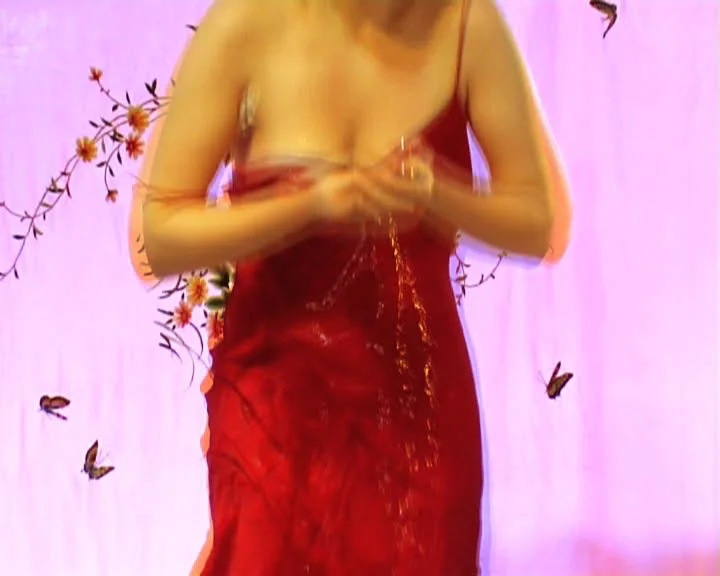
IMAGE DESCRIPTION: A femme in a red nightgown with spaghetti straps is shown from shoulders to hips. She stands in front of a translucent purple curtain embroidered with orange and purple flowers and butterflies. This time, the spaghetti strap has slipped down her right shoulder. Water spills from her cupped hands as she brings them toward her.
INSIDE 4
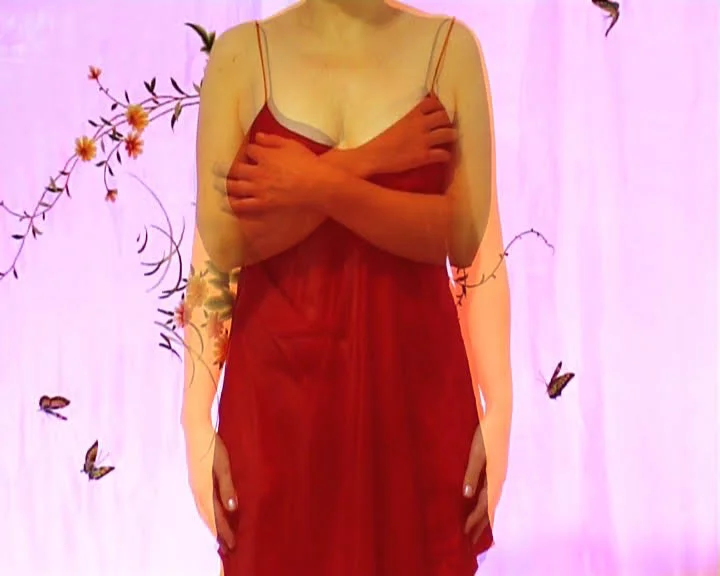
IMAGE DESCRIPTION: A femme in a red nightgown with spaghetti straps is shown from shoulders to hips. She stands in front of a translucent purple curtain embroidered with orange and purple flowers and butterflies. Her hands are doubled to show movement. She holds her hands at her sides and then crosses them over her chest.
Artist statement:
Inside
05:22, 2010
A poetic divergence of body and mind.
The camera is fixed on the body of a woman in a red, silky dress; the image is multi-layered, doubling her tentative moves. Her face is out of frame; it is the body, its nervous expression and search that the camera is fixed on. At first, her movement appears to be out of synch; it splits into two only to melt into each other again; like too many minds in one. The dress is skin, her story, her self she cannot escape from. The sound creation enhances the tension expressed by the winding, the pulling and twitching of her body. Water is a refreshing but foremost a cleansing element; washing off memories, experiences; freeing the subconscious mind. The sudden moment of silence is like holding one’s breath and becoming aware of the moment and the self. ‘Inside’ evinces the attempt to heal after a distressing life experience and to become One again.
In 2021, I had to face suddenly a life threatening and life changing condition, which lead to several surgeries of the brain. Under those kind of exceptional circumstances one might also alter the understanding of ones body and existence. I have always been interested in body and mind correlations; now, my personal experience has certainly left deep traces in me. My work evolves around the human body and mind. Earlier in the form of painting, I now focus on drawing, video and digital photography. Former research on the human mind, as well as collaborations with neuroscientists, have nourished my work and understanding of the human. I still appreciate input from outside; then again, I seek to create in solitude revealing physical and emotional intimacy, fragility and rawness of emotions. My approach is direct trying to keep the means simple; the camera is fixed and turns into the sole witness to this instant. Most times, I am the performer of my videos and model to photos. I am always searching for a poetic approach, a sensual and pensive touch.
Yael Valencia Aldana
INHERITANCE
Memory, the beauty of body
my mother’s, my aunt’s, my sister’s
I now inhabit. middles burgeoning
with middle age, Macintosh shaped
panza included, thickening legacy
of a misplaced Grandmother.
The memory of this body is supposed
to be sad, handed down, plied
with desperation to remain shadowy
gleaning slim, gleaning sexy
from the side of a toxic cleanse box.
this wasteland of a body, my body
this memory curveballs, still true,
into newborn promise every morning.
unhemmed by Facebook ad
expectations. I jiggle my panza like
a brand new toy.
Jen Karetnick
SELF-PORTRAIT WITH MENOPAUSE AND MELASMA
The numbers say that all year I’m twin flames.
In the mirror, I am purple circles
under eyes and a patchwork rug of skin.
Inside, I weather the storm and the lull.
In the mirror, I am purple circles
on the eroded map of middle age.
Inside, I weather the storm and the lull,
balancing these odd hot flashes of rage.
On the eroded map of middle age
I opt for the balm of the tropical,
balancing these odd hot flashes of rage
with the open refrigerator’s cool.
I opt for the balm of the tropical.
I cleanse the house of my body with sage,
with the open refrigerator’s cool
drafts, scented with the promise of fresh eggs.
I cleanse the house of my body with sage,
under eyes, on this patchwork rug of skin.
Drafts are scented with the promise of eggs.
The numbers say that all year I’m twin flames.
Anne Champion
THE HUNTER
The day you installed the microphone in my apartment, you’d broken my heater
and feigned ignorance of how to fix it. For six hours, you methodically unraveled
pieces of yourself as cautiously as the wires twisting between your fingers. I handed empathy
like I was passing tools—the more I put into your palm, the more you confessed:
the dirt floor of your childhood home; your abusive, alcoholic father; the drive-by shooting;
the teenage prison sentence; the men who held your limbs down and tattooed your testicles.
I must’ve done something very bad in a past life to deserve this life. I didn’t fear you or flinch.
Have you ever seen that Netflix show about a stalker? you asked. Yes, very dark, I replied.
The more you unfurled, the closer you moved towards me. I could feel the heat radiating
off your skin. When your arm touched mine as you pressed against me shoulder to shoulder
to show pictures on your phone, it felt like an electric zap. There you were, palms gripping
horned beasts slayed, while I cooed and beamed like a mother cradling her newborn son.
I had no idea that someday, I’d be the carcass you gripped, the prey you hunted, the empty-
eyed, slack-bodied picture on your phone, the proof of your power in your palm.
Fox Henry Frazier
GANGSTER BLOOD AND FINAL GIRLS
What do you call a girl whose DNA already understands
how to disappear? As in, our forebears fucked with cartels,
pissed off the Crown, had to slip quickly unseen into new
worlds: passless portless peerless we grew up
wrist-bangers, cutters, addicted by age eight to our hot pink slap
bracelets. By eleven, playing quarters with the boys. Nickels stick hard
in your knuckles but there was something elegant about that thinner,
spinning, minted silver. Our fingers were so delicate: when either of us
toppled a coin, it was because we already understood our power
was proving exactly how much more we could bleed. What do you call
a girl whose DNA already understands the game where friends
choke each other out until one goes weak-kneed? Disjointed fingers, unsocketed arms,
elbows bent backwards until one squeals mercy? There are certain
countries she can’t go back to. Certain states she’ll never be able to enter.
I was most in my element doing candlewax spills on different
parts of my body, girlfriends admiring the gasp and the burn like they could
learn from me. They could. I held my fingers in fire and counted
the occasional blister a trophy. Nail polish is flammable, but pain
is beauty and all lines blur with pus and ooze at some point. My great-grandmother
was bulleted into pieces in front of her children by angry men with guns. Who
could blame her sons for whatever they grew up to be,
or the children of their blood, one of whom then begat me? What do you
call a girl whose DNA choreographs the routine of how to cut herself apart
for fun because against your kind, she’ll always be the only one
walking away while the credits unspool? What did you think we were
playing this game for if not the better to quietly bleed
you out while you enjoy watching us bite our lips and moan?
Lorelei Bacht
YARN DOLL
i dislike this vessel: the ceramic
of existence contained, made stained
glass and boulder. i dislike the shoulder,
the arm, the might
or might not stop
of the pretty red clock. i dislike the given
that grows and shows
signs of ancient. i dislike the bedknobs,
elastics, surgery, radium
lurking just around that
corner. i dislike for i desired
a safer, more durable weave than this
gossamer house, this water
strider print.
Issue 102 Contributors
Yael Valencia Aldana is a Caribbean Afro-Latinx writer and poet. She is a descendant of the indigenous people of modern-day Colombia. She is the author of the chapbook, Alien(s). Her work has also appeared or is upcoming in Stone Coast Review, South Florida Poetry Journal, and Cutbank Literary Journal, among others. She teaches creative writing in South Florida, where she lives with her son and too many pets. You can find her online at YaelAldana.com.
Lorelei Bacht (she/they) is a middle-ageing embodiment, currently located in Asia. Their recent writing has appeared and/or is forthcoming in Feral, Anti-Heroin Chic, Sinking City, SWWIM, Corporeal, Barrelhouse, Hecate, and elsewhere. They are also on Instagram: @lorelei.bacht.writer and on Twitter @bachtlorelei .
Anne Champion is the author of She Saints & Holy Profanities (Quarterly West, 2019), The Good Girl is Always a Ghost (Black Lawrence Press, 2018), Book of Levitations (Trembling Pillow Press, 2019), Reluctant Mistress (Gold Wake Press, 2013), and The Dark Length Home (Noctuary Press, 2017). Her work appears in Verse Daily, diode, Tupelo Quarterly, Prairie Schooner, Crab Orchard Review, Salamander, New South, Redivider, PANK Magazine, and elsewhere. She was a 2009 Academy of American Poets Prize recipient, a 2016 Best of the Net winner, and a Barbara Deming Memorial Grant recipient.
Jillian Clasky is a writer from Toronto. She currently lives in Ottawa, where she is studying English and creative writing. Her work has appeared or is forthcoming in journals such as PRISM international, Rust & Moth, and Vagabond City.
Fox Henry Frazier is the author of The Hydromantic Histories, Raven King, and several other collections. She created and co-runs the literary press Agape Editions, the arts & lit magazine Alice Says Go Fuck Yourself, and the Favorite Poems reading series. Fox holds a PhD from the University of Southern California and an MFA from Columbia University. She lives in upstate New York. Instagram: @chansondemelusine .
Vanessa Couto Johnson (she/they) is the author of the full-length poetry books pH of Au (Parlor Press, Free Verse Editions Series 2022) and Pungent dins concentric (Tolsun Books, 2018), as well as three poetry chapbooks. Most recently, VCJ's poems have appeared in Ballast, L=Y=R=A, The Broken City, and Rough Cut, among others.
The winner of the 2022 Cider Press Review Book Award for Inheritance with a High Error Rate (January 2024), Jen Karetnick is the author of 10 additional poetry collections. The co-founder/managing editor of SWWIM Every Day, she has forthcoming work in Cimarron Review, Cold Mountain Review, Harpur Palate, Shenandoah, South Dakota Review, and elsewhere. See jkaretnick.com or visit her on Instagram at Jen Karetnick or on Twitter @Kavetchnik.
Lisa Marie Oliver is the author of Birthroot (forthcoming, Glass Lyre Press.) Recent poems can be found in Tupelo Quarterly, The River Heron Review, and Parentheses Journal. She lives and writes in Portland, Oregon.
Monique Quintana is a Xicana from Fresno, CA, and the author of Cenote City (Clash Books, 2019). Her work has appeared in Wildness, Lost Balloon, The Acentos Review, and other publications. She has been supported by Yaddo, the Sundress Academy for the Arts, the Kimmel Harding Nelson Center, and the Community of Writers. You can find her at moniquequintana.com. Instagram and Twitter: @quintanagothic
Simone Stoll was born in 1967 in Frankfurt/Main, Germany. Her interest lies in the understanding of human mind and body connection; in form of painting, drawing, she has since focused on digital work. She has participated in video festivals, group and solo shows internationally. In 2007, she was part of the Biennale of Québec and received the Pollock Krasner Foundation Grant. In 2011, she took part in the Bienal Internacional de Fotografía de Tenerife and was given the Fotonoviembre Award.
Kristin Camitta Zimet is the author of Take in My Arms the Dark, a full-length collection of poems, and the long-time editor of The Sow's Ear Poetry Review. Her poetry is in journals and anthologies in eight countries. It has been performed in concert halls and museums and has hung on the walls of art galleries. She is also a Reiki healer, hospital volunteer, surreal photographer, and master naturalist.